
Image by Jose Marroquin on Unsplash
Key Takeaways
- Paleo emphasizes whole foods but excludes grains, legumes, and dairy.
- It may help with short-term weight and metabolic outcomes, but evidence is less extensive than for Mediterranean or DASH.
- Because it removes several food groups, planning for fiber, calcium, and overall nutritional adequacy matters.
The Paleo diet is an eating pattern based on foods believed to resemble those available to humans during the Paleolithic era. It typically emphasizes vegetables, fruits, meat, fish, eggs, nuts and seeds while excluding grains, legumes and dairy.
- How the Paleo Diet Works
- Paleo Food List: What to Eat and What to Avoid
- Sample Meal Ideas
- Does Paleo Help With Weight Loss?
- Evidence for Weight and Metabolic Health
- Benefits: What the Evidence Suggests and Where It's Limited
- Nutrition Concerns to Plan Around
- Who Should Be Cautious
- Paleo vs. Keto
- Paleo vs. Mediterranean
- How to Start
- FAQ
- References
How the Paleo Diet Works
Paleo is a modern dietary pattern inspired by the foods thought to have been available before agriculture. There is no single standardized Paleo diet, and definitions vary, particularly around foods such as potatoes, vegetable oils, and certain processed ingredients.
In practice, most versions of Paleo center on whole, minimally processed foods and move away from bread, pasta, rice, beans, milk, cheese, and sugar-sweetened products.
Proponents argue this way of eating fits how humans evolved to eat; critics point out that modern produce and livestock differ substantially from what Paleolithic humans actually had access to, so the historical framing works more as an organizing idea than a literal recreation.
Paleo Food List: What to Eat and What to Avoid
Food rules vary between Paleo versions, so readers should check which definition a particular plan uses.
Commonly included foods:
- Meat and poultry
- Fish and seafood
- Eggs
- Vegetables
- Fruit
- Nuts and seeds
- Some minimally processed fats
Commonly excluded foods:
- Grains
- Legumes
- Dairy
- Refined sugar
- Most ultra-processed foods
- Other foods excluded by the specific Paleo version
A few foods people often ask about:
- Potatoes: Treatment varies by Paleo version. Some stricter versions exclude them, while other modern approaches allow certain tubers.
- Rice and oats: Generally excluded, since most Paleo definitions treat grains refined and whole as off-limits.
- Beans and lentils: Generally excluded, since legumes are typically considered a post-agricultural food group.
- Dairy: Generally excluded, including milk, cheese, and yogurt, though some modern versions make exceptions for foods like ghee.
- Eggs: Commonly included and used as a protein source.
Sample Meal Ideas
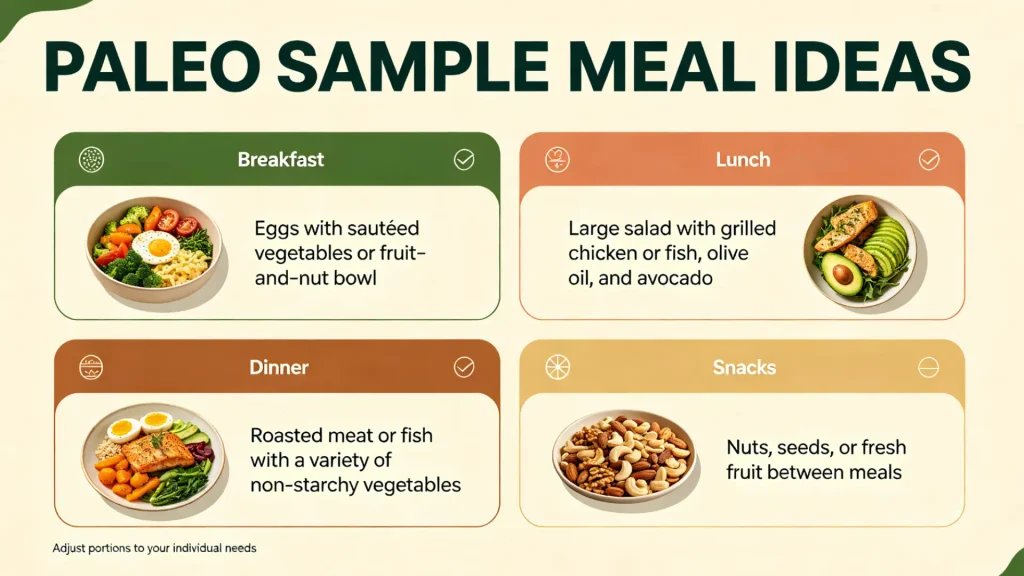
adjust portions and specific foods to your own needs
A Paleo day might look something like this:
- Breakfast: Eggs with sautéed vegetables, or a fruit-and-nut bowl
- Lunch: A large salad with grilled chicken or fish, olive oil, and avocado
- Dinner: Roasted meat or fish with a variety of non-starchy vegetables
- Snacks: Nuts, seeds, or fresh fruit
These are illustrative starting points rather than a fixed meal plan portion sizes and specific foods should be adjusted to your own needs and any medical guidance you’ve received.
Does Paleo Help With Weight Loss?
Paleo may support weight loss partly because it emphasizes minimally processed foods and eliminates many energy-dense processed foods and added sugars. It does not necessarily require a low-carbohydrate intake, and results vary by individual and by how strictly a given version of the diet is followed.
Evidence for Weight and Metabolic Health
Randomized trials suggest that Paleo can improve body weight and some cardiometabolic markers, particularly over the short term. However, studies vary substantially in how Paleo is defined, and long-term evidence remains less extensive than for dietary patterns such as Mediterranean or DASH.
This doesn’t mean Paleo is proven superior to those patterns, it means the two are simply supported by different amounts and types of evidence.
Benefits: What the Evidence Suggests and Where It’s Limited
Some studies have found improvements in waist circumference or blood sugar markers over a period of months, particularly compared to a typical Western diet.
Some of these effects may reflect the emphasis on minimally processed foods and the reduction of added sugars and other highly processed foods, rather than a uniquely Paleolithic mechanism.
Evidence remains limited regarding Paleo’s long-term effects compared to more extensively studied patterns, so any benefits are worth treating as promising rather than settled.
Nutrition Concerns to Plan Around
Because Paleo eliminates entire food groups, a few things are worth planning around:
- Fiber: Removing whole grains and legumes can lower fiber intake unless it’s replaced with enough vegetables, fruit, and nuts.
- Calcium and vitamin D: Removing dairy can make calcium intake harder for some people, so alternatives such as canned fish with bones, calcium-fortified foods, or suitable vegetables may need to be included. Vitamin D intake may also require attention depending on diet and individual circumstances.
- Cost and sustainability: A diet built around meat, fish, and fresh produce can be more expensive and harder to maintain long term than more flexible patterns.
- Social and practical friction: Excluding grains, legumes, and dairy can make eating out or shared meals more complicated.
Who Should Be Cautious
Eliminating multiple food groups can create nutritional or practical concerns for some people, including:
- Pregnant or breastfeeding people
- People with a history of disordered eating, given the diet’s restrictive nature
- People with kidney disease, particularly if the diet would substantially increase protein intake individualized dietary advice is worth getting before starting
- Athletes or highly active people whose training diet relies heavily on carbohydrate-rich foods may need individualized guidance before making major dietary changes
Paleo vs. Keto
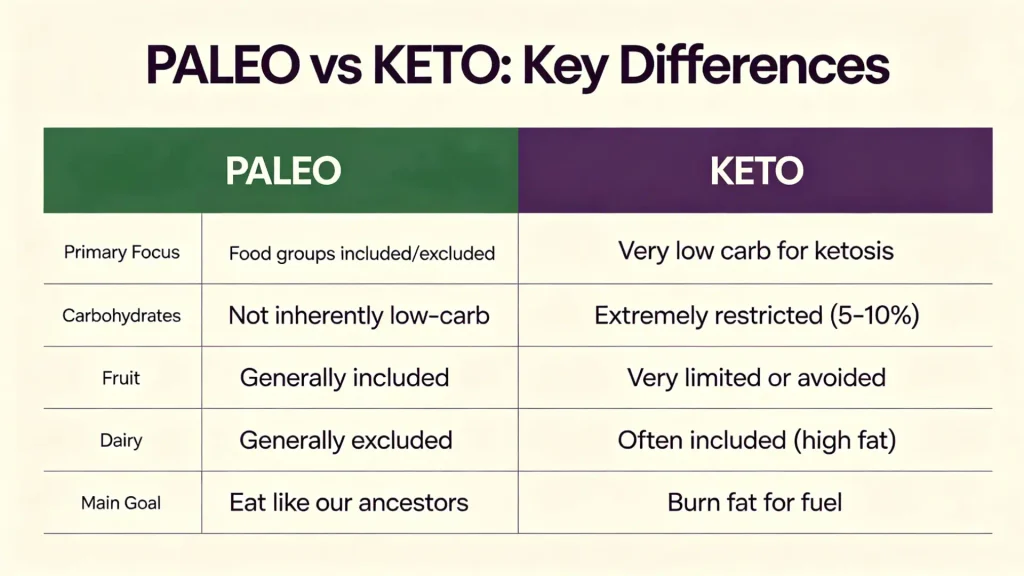
while keto is defined mainly by restricting carbohydrates to reach ketosis
Paleo and keto are not the same diet. Paleo is defined primarily by which foods are included or excluded, while keto is defined mainly by keeping carbohydrate intake very low to achieve nutritional ketosis.
A Paleo diet can include fruit and some starchy vegetables and is not inherently low in carbohydrates. For a full breakdown of how keto works, see Detoxoz’s Keto diet meal plans guide.
Paleo vs. Mediterranean
The two patterns diverge mainly on grains, legumes, and dairy: Mediterranean generally includes whole grains, legumes, and dairy or fermented dairy foods as staples, while Paleo generally excludes them.
The Mediterranean has a larger long-term evidence base for cardiovascular health, though this reflects how much each pattern has been studied rather than one being universally better.
If you’re weighing evidence-backed options against your goals more broadly, Detoxoz’s guide on how to choose the right diet for you compares Paleo alongside Mediterranean, DASH, low-carb, and other patterns.
How to Start
If you’re considering trying Paleo:
- Build meals around a protein source, vegetables, and healthy fat.
- Plan ahead for fiber and calcium, since those are the nutrients most likely to drop when grains, legumes, and dairy are removed.
- Check in with a doctor or dietitian if you have any existing health conditions or plan to follow it long term.
FAQ
Is Paleo healthier than Keto?
Neither is universally healthier. Paleo focuses on food quality and exclusion of certain food groups, while keto focuses on very low carbohydrate intake. The better choice depends on individual goals, preferences, nutritional needs, and long-term adherence
What are the disadvantages of the Paleo diet?
Paleo can be restrictive because it excludes grains, legumes, and dairy. This may make it harder for some people to meet nutritional needs such as calcium and fiber or to maintain the diet socially and long term.
Is Paleo healthy long term?
A well-planned Paleo-style diet can include many nutritious whole foods, but long-term evidence is less extensive than for some established dietary patterns. Because several food groups are excluded, nutritional adequacy and individual needs should be considered.
References
This article was reviewed against current scientific literature and guidance from established health organizations. It is for general informational purposes and is not medical advice.
- Bahrami M, Bakhshimoghaddam F, Ahangarpour A, Jafarirad S. The Paleolithic diet and chronic disease risk: a GRADE-assessed systematic review and dose-response meta-analysis of prospective cohort studies and randomized controlled trials. Critical Reviews in Food Science and Nutrition. 2026. https://pubmed.ncbi.nlm.nih.gov/41129328/
- de la O V, Zazpe I, Martínez JA, et al. Scoping review of Paleolithic dietary patterns: a definition proposal. Nutrition Research Reviews. 2021;34(1):78–106. https://pubmed.ncbi.nlm.nih.gov/32482184/
- Ghaedi E, Mohammadi M, Mohammadi H, et al. Effects of a Paleolithic Diet on Cardiovascular Disease Risk Factors: A Systematic Review and Meta-Analysis of Randomized Controlled Trials. Advances in Nutrition. 2019;10(4):634–646. https://pubmed.ncbi.nlm.nih.gov/31041449/
- NIH Office of Dietary Supplements. Calcium Health Professional Fact Sheet. https://ods.od.nih.gov/factsheets/Calcium-HealthProfessional/
Medical disclaimer: This article is for general information only and isn’t a substitute for personalized medical or dietary advice. Because Paleo eliminates several food groups, talk to a doctor or registered dietitian before starting if you have a health condition, take medication, or are pregnant or breastfeeding.