Image by Hanna Witte on Unsplash
Key Takeaways
- Walking yoga combines walking, mindful breathing, and gentle movement, but it is not a standardized clinical protocol.
- Its potential benefits come mainly from the established effects of walking, yoga, and mindfulness rather than research on walking yoga itself.
- It is a gentle option for beginners, but it does not replace regular aerobic or strength training when those are the goal.
Walking yoga is generally a low-intensity, low-impact practice when performed with comfortable walking and gentle movements, combining the rhythm of walking with the breathwork, body awareness, and gentle stretching associated with yoga.
Rather than flowing through a full sequence of poses on a mat, you walk at a relaxed pace, sync your breath to your steps, and pause occasionally for a stretch, a shoulder roll, or a moment of stillness.
While there’s no dedicated clinical research on walking yoga as a named protocol, its two component practices mindful walking and yoga each have a meaningful evidence base behind them.
What Is Walking Yoga?
Walking yoga does not have a standardized clinical definition. In this article, the term refers to a self-directed practice combining walking, mindful attention, breathing, and occasional gentle stretching.
A typical session might start with a few minutes of relaxed walking while you settle your breath, followed by natural pauses for a standing forward fold, a gentle spinal twist, or a side stretch, then a return to walking.
Some people integrate movement into the walk itself shoulder rolls or arm swings while moving rather than stopping.
There’s no official governing standard, so instructors and practitioners vary in how much of the yoga is stretching versus how much is simply mindfulness applied to walking.
How is it different from walking meditation?
Walking meditation, which has roots in Buddhist practice, is generally about sustained, non-judgmental attention to the sensations of walking itself, the feeling of each foot making contact with the ground, the rhythm of breath usually without added stretches or poses.
Walking yoga borrows that same attentional quality but adds intentional movement breaks, making it slightly more active and physically varied.
How is it different from a regular walk or traditional yoga?
Compared to a regular walk, the difference is intention: walking yoga asks you to pay deliberate attention to breath, posture, and body sensation rather than just covering distance.
Compared to a traditional yoga class, it trades a structured sequence of poses on a mat for a small number of simple stretches woven into a walk outdoors. You get less depth of stretching, but more cardiovascular movement in the same session.
| Walking Yoga | Walking Meditation | Traditional Yoga | |
| Main focus | Breath, movement, and light stretching combined | Present-moment awareness of walking itself | Structured pose sequences and deeper stretching |
| Physical intensity | Light to moderate, continuous movement | Typically slow and minimal | Varies widely by style |
| Setting | Outdoors or indoors, while moving | Often a fixed path, indoors or outdoors | Usually a mat, studio, or dedicated space |
| Equipment | None | None | Mat recommended |
| Best suited for | People who want mindfulness and movement together | People primarily seeking a meditative practice | People prioritizing flexibility, strength, or a full practice |
How Does Walking Yoga Work?
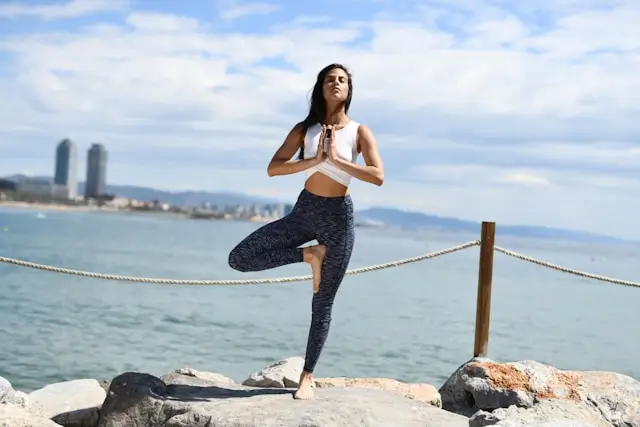
Image by FORMM agency on Unsplash
The proposed mechanism behind walking yoga is really the combined mechanisms of its two parts.
Walking itself is one of the most consistently supported forms of physical activity for cardiovascular health, mood, and general fitness, as covered in more depth in our detox fitness guide.
Layering mindful breathing on top of that doesn’t change the physiology of the walk, but it engages attention and the body’s relaxation response in a way that unstructured walking doesn’t necessarily do on its own.
Yoga, separately, has research behind it mostly preliminary to moderate in strength for stress management, flexibility, and balance.
According to the National Center for Complementary and Integrative Health, yoga may help people manage stress and improve balance when practiced regularly, though the agency also notes that research on yoga for general well-being is still limited and findings haven’t been fully consistent.
Walking yoga can be used as a low-intensity way to combine walking with mindful attention and gentle movement.
What the Evidence Actually Supports
There are no large controlled trials specifically testing walking yoga as a defined intervention. What exists is evidence for its two ingredients separately, plus a smaller body of research on mindful walking more broadly.
Walking’s benefits are well established
Regular walking is well supported for cardiovascular fitness, physical function, and several aspects of general health.
This is some of the best-supported territory in exercise science, and it doesn’t depend on adding mindfulness or stretching to get those benefits.
Yoga’s evidence for stress and balance is real but described by NCCIH as preliminary to moderate
Some research indicates yoga practice can lead to improvements in physical or psychological aspects of stress, and regular practice may improve balance and relieve tension.
Mindful walking specifically has a smaller, separate body of research
Reviews describing walking meditation suggest it may support reduced stress and anxiety, improved mood, and better sleep quality, largely drawing on the broader mindfulness literature rather than trials of walking meditation in isolation.
The specific benefits of walking yoga cannot be assumed to equal the benefits demonstrated for walking, yoga, or mindfulness separately
Combining two evidence-supported practices may be useful, but the combination itself has not been isolated and studied as its own intervention.
Benefits of Walking Yoga
Based on the evidence for its component parts, here’s what walking yoga plausibly offers:
- Cardiovascular movement from the walking component, consistent with general walking research
- Stress management support, drawing on yoga and mindfulness research, though the size of the effect for a brief walking-based practice specifically hasn’t been isolated
- Gentle flexibility and mobility gains from the stretches, though likely more modest than a full yoga class given less time spent in each pose
- Improved body awareness and posture attention during movement
- A low-barrier entry point into both mindfulness and gentle movement for people who find a still meditation practice or a full yoga class hard to start with
It’s worth noting what it’s less likely to deliver: meaningful strength gains, significant flexibility improvement compared to a dedicated stretching or yoga routine, or measurable weight loss on its own.
Movement-based mindfulness practices, including walking meditation, generally don’t produce significant weight change by themselves.
Is Walking Yoga Good for Beginners?
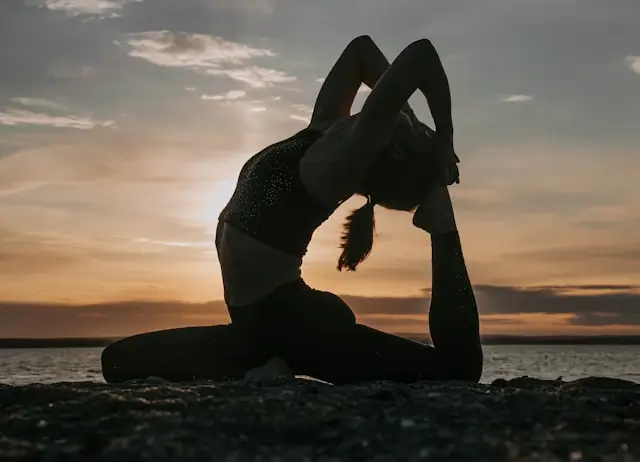
Image by Juliana Araujo the artist on Unsplash
Yes it’s one of the more accessible mind-body practices to start with. It requires no equipment, no studio, and no prior yoga experience, and the pace and stretch intensity are entirely self-directed.
That said, if you’re new to yoga poses generally, it’s worth learning a handful of basic stretches beforehand (from a class, video, or instructor) so you’re doing them with reasonable form during your walk.
A Simple Beginner Walking Yoga Routine
This is a practical beginner routine created for this article, not a clinically validated walking-yoga protocol.
Adjust pace, duration, and stretch selection to your own comfort and fitness level, and stop walking completely before any standing stretch or balance movement perform those on stable, level ground.
- Settle in (2–3 minutes). Begin walking at a relaxed, comfortable pace. Bring your attention to your breath without trying to control it yet.
- Sync breath to steps (3–5 minutes). Try inhaling for two or three steps and exhaling for two or three steps, adjusting the count to whatever feels natural rather than forcing a rigid pattern.
- First movement break (1–2 minutes). Stop on stable ground and do a few slow shoulder rolls, followed by a gentle overhead reach and side stretch on each side.
- Continue walking mindfully (5–10 minutes). Bring attention to the sensations of each step, the movement of your arms, and what you notice around you.
- Second movement break (1–2 minutes). Stop again on stable, level ground for a standing forward fold (bending gently from the hips, knees soft) followed by a slow spinal twist in each direction.
- Close the walk (2–3 minutes). Return to relaxed walking, letting your breath settle back to normal before finishing.
A full session usually runs 15 to 30 minutes. A practical starting point is a few sessions per week, although there is no established frequency specific to walking yoga.
Common Mistakes to Avoid
- Overloading the walk with too many poses. Adding a long sequence of stretches turns the practice into stop-and-start yoga rather than walking yoga, and can interrupt the rhythm that makes it work.
- Forcing a rigid breath count. A forced or uncomfortable breathing pattern tends to create tension rather than relax if the count is a guide, not a rule.
- Attempting advanced poses mid-walk. Balance-heavy or deep stretches are better done seated or on stable ground, not while transitioning in and out of a walking pace.
- Treating it as a substitute for structured exercise. Walking yoga is a gentle, low-intensity practice; it’s a reasonable complement to strength training or more vigorous cardio, not a replacement for either if those are also goals.
- Practicing on uneven or distracted terrain. Save the stretches and closed-eyes breathing moments for stable, quiet ground rather than busy streets or uneven trails.
Who May Need to Modify the Practice
People with balance concerns, vertigo, or a recent injury should be cautious with any pauses that involve closing the eyes, standing on one leg, or deep forward bends, and may want guidance from a physical therapist on which stretches are appropriate.
Anyone with an uncontrolled heart condition or joint pain that limits walking should also get individualized guidance before starting a new movement routine, gentle as walking yoga is.
If you’re looking for a more structured, cardio-focused walking workout rather than a mindfulness-based one, our comparison of Japanese walking vs. 12-3-30 covers two evidence-backed interval walking formats.
Related posts:
Detox Fitness: The Science-Backed Guide to Exercise
Japanese Walking vs 12-3-30: Fat Loss, Cardio Fitness & Joint Impact
Frequently Asked Questions
Does walking yoga count as exercise?
It counts as light physical activity, primarily from the walking component. It’s not a substitute for the moderate-to-vigorous aerobic activity or muscle-strengthening work recommended in general physical activity guidelines, but it can be a reasonable addition to an active lifestyle or a gentle starting point for people who are currently inactive.
Do you need any equipment for walking yoga?
No. Comfortable, supportive shoes and clothing that allow unrestricted movement are sufficient.
How long should a beginner practice walking yoga?
Most beginners do well starting with a single 15 to 20 minute session a few times a week, rather than a daily practice. There’s no minimum duration required for it to be worthwhile.
Even a short walk with a few mindful stretches can be a reasonable starting point, and you can extend the time as it becomes a comfortable habit.
References
- National Center for Complementary and Integrative Health (NCCIH). Yoga: Effectiveness and Safety. National Institutes of Health.
- National Center for Complementary and Integrative Health (NCCIH). Meditation and Mindfulness: What You Need To Know. National Institutes of Health.
- World Health Organization. WHO Guidelines on Physical Activity and Sedentary Behaviour. 2020.
- Cleveland Clinic. Walking Meditation: What It Is and How to Practice It.
This article is for informational and educational purposes only and does not replace professional medical advice. Consult a qualified healthcare provider before starting a new exercise routine, particularly if you have an existing medical condition, balance concerns, or joint pain.