Image by Victor Freitas on Unsplash
Key Takeaways
- No single exercise reliably raises resting testosterone; resistance training is valuable mainly for strength, muscle, and metabolic health.
- Exercise can cause a temporary testosterone rise, but long-term changes in resting testosterone are generally small or inconsistent, especially past midlife.
- Sleep, adequate nutrition, and recovery matter alongside exercise and if you have symptoms of low testosterone, that calls for medical evaluation, not a workout plan.
No single best exercise reliably boosts testosterone on its own. The strongest evidence supports regular resistance training, moderate aerobic activity, and adequate recovery for overall health after 40 muscle, strength, metabolic function, sleep. These benefits are far more consistent than any lasting rise in your lab-measured resting testosterone, which the current research can’t reliably promise.
If the goal is overall health after 40, resistance training is the strongest starting point; if the goal is specifically raising resting testosterone, no exercise protocol has a consistently proven advantage.
- Why this question is more complicated than it sounds
- Acute spike vs. long-term change: the distinction that matters most
- Resistance training after 40: what it reliably does and doesn't do
- Where cardio and aerobic exercise fit
- HIIT vs. steady-state cardio vs. resistance training
- Recovery, sleep, and energy availability
- A realistic weekly framework
- Who should be cautious
- When to talk to a doctor
- Bottom line
- References
Why this question is more complicated than it sounds
Search results and fitness content often present exercise as a straightforward testosterone hack, lift heavy, get more testosterone, look and feel younger.
The physiology is real, but the size and durability of the effect are smaller and less consistent than that framing implies, especially once age enters the picture.
Testosterone tends to decline gradually with age, although the rate varies substantially between men. That decline is one reason exercise and testosterone searches spike for men in their 40s and 50s but it also means the men asking this question are working against a baseline drift that exercise alone doesn’t reverse.
This article separates what’s well established from what’s still uncertain, and gives you a practical, evidence-aligned training approach rather than a promise of a specific hormonal outcome.
It’s part of our men’s hormonal health series; for the broader relationship between chronic stress and testosterone, see our guide to stress and low testosterone.
Acute spike vs. long-term change: the distinction that matters most
Most of the confusion around exercise and testosterone comes from conflating two different things.
What happens right after a workout (acute response)
A single bout of resistance exercise particularly heavy, compound lifting like squats, deadlifts, and presses produces a measurable, short-lived rise in circulating testosterone, detectable immediately after the session and within about the first 30 minutes afterward.
A systematic review of randomized controlled trials on acute exercise found that this rise is generally larger and slower to fade after resistance training than after aerobic exercise, where testosterone typically returns to baseline within about an hour. This acute pattern is one of the most consistent findings in exercise endocrinology.
What it does not tell you is whether your resting testosterone, the number a blood test would show on a random morning, unrelated to a recent workout is any higher because you train.
Some studies also suggest this acute response becomes smaller with age: comparisons of younger and older men doing the same heavy resistance protocol have generally found smaller increases in the older groups.
What happens to your baseline level over weeks and months (chronic adaptation)
The evidence here is weaker and more mixed. A 2021 meta-analysis in the Journal of Strength and Conditioning Research, pooling randomized controlled trials in previously inactive, healthy men, found that exercise training aerobic, resistance, or combined had a negligible overall effect on resting total testosterone compared with inactive controls.
A separate meta-analysis focused specifically on older men reached a similar conclusion for resistance training alone, finding no significant effect on basal testosterone.
Aerobic and interval training showed small, statistically significant increases in that same analysis, though the real-world importance of an effect that small is still unclear.
Taken together, the honest expectation should be that training supports the hormonal environment and the things testosterone helps regulate, not that it will visibly raise your testosterone number.
Resistance training after 40: what it reliably does and doesn’t do
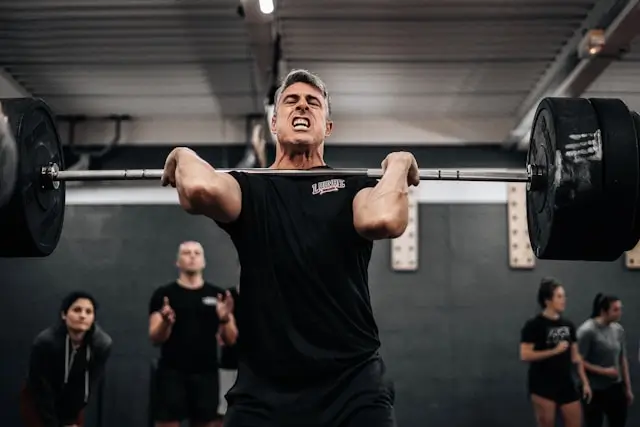
Image by Marvin Cors on Unsplash
Resistance training is one of the most useful exercise types after 40 for muscle, strength, bone, and metabolic health, even though its effect on resting testosterone is not consistently large.
What’s well supported
- Muscle mass and strength. Randomized trials in men in their 60s and 70s show resistance training reliably increases lean mass and strength, even without added testosterone therapy.
- Body composition, indirectly linked to testosterone. Visceral fat increases activity of the enzyme aromatase, which converts testosterone to estradiol, and is associated with lower circulating testosterone in men with excess body fat. Resistance training’s effect on body composition may partly explain why active men tend to have more favorable testosterone profiles than sedentary men with obesity, even though the direct hormonal effect of a training program is small.
- Functional and metabolic health. Grip strength and muscle power both trainable with resistance work are associated with lower all-cause mortality risk in long-term cohort studies, independent of testosterone level.
What’s not well supported
- A large, dependable rise in resting testosterone from training alone. As covered above, this isn’t well supported by controlled trials, particularly past midlife.
- More sets, more testosterone. Higher training volume produces a bigger acute hormonal spike in single-session studies, but this hasn’t translated into a clear dose-response relationship for resting testosterone over the long term.
Practical program design
Based on the exercise types studied in the research above, a reasonable evidence-aligned approach is:
- Frequency: Two to three resistance sessions per week, matching current U.S. physical activity guidelines for muscle-strengthening activity on 2 or more days a week covering all major muscle groups.
- Exercise selection: Prioritize exercises that train all major muscle groups, using compound, multi-joint movements (squats, deadlifts, presses, rows) where appropriate.
- Load and effort: Work in a moderate-to-high effort range sets taken close to, but not always to, failure rather than very light, high-repetition circuits.
- Recovery between sessions: Allow enough recovery between sessions for the same muscle groups, with frequency adjusted to training experience, intensity, and recovery capacity.
Where cardio and aerobic exercise fit
Aerobic exercise plays a different role than resistance training here. Its acute testosterone response is smaller and shorter-lived, generally returning to baseline within about an hour.
A meta-analysis of aerobic training in people with obesity or type 2 diabetes found it can raise circulating testosterone in men, a pattern researchers link to improved insulin sensitivity and reduced fat mass, not a direct hormonal effect of the cardio itself.
In the older-men meta-analysis discussed earlier, aerobic and interval training were associated with small but statistically significant increases in resting testosterone, in contrast to resistance training alone.
So cardio is worth keeping in your routine after 40, but mainly for its own well-established cardiovascular and metabolic benefits rather than as a testosterone strategy.
Current U.S. guidelines recommend at least 150 minutes of moderate-intensity aerobic activity per week (or 75 minutes vigorous), which pairs well with a 2–3 day resistance routine without creating excessive total training stress for most healthy adults.
HIIT vs. steady-state cardio vs. resistance training
HIIT sits between resistance and steady-state cardio in its hormonal profile: both cortisol and testosterone rise sharply during and right after a session, dip below baseline afterward, then return to normal within about a day.
One controlled study in men aged 35–40 found that an eight-week HIIT program favorably shifted the testosterone-to-cortisol balance alongside gains in physical fitness a useful data point, but a single study in a narrow age range, not proof that HIIT reliably outperforms resistance training for hormone health.
For most men over 40, HIIT is a reasonable addition once you have a baseline of cardiovascular fitness and recovery capacity not a replacement for resistance training, and not something to layer on top of an already demanding schedule without trimming volume elsewhere.
Image by Adam Davis on Unsplash
Recovery, sleep, and energy availability
Very high training loads combined with inadequate recovery or energy intake can disrupt hormonal function in some men. Endurance athletes carrying very high training loads have shown measurable drops in resting testosterone alongside a decline in the testosterone-to-cortisol ratio, a pattern used for decades as a rough marker of accumulated training stress.
That ratio is a research tool, not a validated individual diagnostic test. A 2013 joint consensus statement from major sports medicine and exercise science societies, and a later systematic review of overtraining studies, both found that basal hormone levels are often normal even in athletes with confirmed overtraining syndrome; there’s no single blood test that reliably diagnoses the condition. In practice, this means:
- Don’t use one hormone panel to declare yourself overtrained.
- Don’t assume normal-looking bloodwork rules out under-recovery.
- Watch for the pattern instead: stalling performance, persistent fatigue, disrupted sleep, and mood changes over time.
If you notice several of these signs, the evidence-based response is a deliberate reduction in training load and closer attention to sleep and nutrition, not more volume, and not necessarily hormone testing on its own.
A realistic weekly framework
This isn’t a rigid prescription of individual circumstances, joint health, and starting fitness level matter but it reflects the exercise types and frequencies most consistently studied in the research above.
| Component | Frequency | Notes |
| Resistance training | 2–3 sessions/week | Compound lifts, moderate-to-high effort, all major muscle groups |
| Moderate aerobic activity | 150 min/week (or 75 min vigorous) | Can be split across several days |
| Optional HIIT | 1 session/week, once conditioned | Not a replacement for resistance training |
| Recovery days | As needed | Adjust according to training load, sleep, fatigue, and fitness level |
Consistency over months, rather than short, aggressive training blocks, is what the underlying research on muscle mass, strength, and metabolic health actually supports. Testosterone is one part of a larger picture that also includes sleep, stress, and body composition.
Who should be cautious
- Men new to vigorous exercise, or with cardiovascular disease, joint problems, or other chronic conditions should check with a doctor before starting resistance training or vigorous aerobic or interval work, per standard physical activity guidance.
- Men experiencing symptoms suggestive of low testosterone, persistent low libido, unexplained fatigue, loss of muscle mass, mood changes shouldn’t rely on a workout plan as a substitute for medical evaluation.
- Men already training at high volume with stalling performance or persistent fatigue should treat that as a signal to scale back and prioritize recovery, not a reason to push harder.
When to talk to a doctor
If symptoms suggest low testosterone, diagnosis requires both compatible symptoms and consistently low testosterone, confirmed with at least two separate early-morning blood tests rather than a single reading, a distinction reflected in current Endocrine Society and American Urological Association guidance.
Exercise habits are one part of a broader hormonal-health picture that also includes sleep, nutrition, and stress management, but they aren’t a substitute for that evaluation.
Bottom line
Exercise is excellent for men’s health after 40 for muscle, strength, metabolic health, and the things testosterone helps regulate but it shouldn’t be marketed or approached as a reliable testosterone-boosting hack. The acute rise after a workout is real and well documented; a lasting increase in your resting testosterone level is not something the current evidence can promise.
References
- Effect of acute exercise on the dynamics of testosterone levels: a systematic review of randomized controlled trials. PeerJ, 2026.
- Effects of Exercise Training on Resting Testosterone Concentrations in Insufficiently Active Men: A Systematic Review and Meta-Analysis. Journal of Strength and Conditioning Research, 2021.
- Short-Term Exercise Training Inconsistently Influences Basal Testosterone in Older Men: A Systematic Review and Meta-Analysis. Frontiers in Physiology, 2018.
- Centers for Disease Control and Prevention. Physical Activity Guidelines for Adults.
- Endocrine Society. Testosterone Therapy for Hypogonadism clinical practice guideline resources and hypogonadism patient guidance.
This article is for general educational purposes and isn’t a substitute for individualized medical advice. If you have symptoms of low testosterone or are considering a significant change to your exercise routine, particularly with an existing health condition, talk to your doctor. This content has not yet undergone physician review.