Key Takeaways
- Declining estrogen during menopause affects collagen, skin thickness, hydration, and barrier function.
- Common changes include increased dryness, reduced elasticity, thinning, and more visible fine lines.
- Evidence-based skincare can support menopausal skin, particularly through moisturization, barrier care, sun protection, and selected active ingredients.
- Skincare can improve the appearance and comfort of menopausal skin, but it cannot completely reverse hormone-related changes.
Menopause changes the skin largely because declining estrogen affects collagen, skin thickness, hydration, and barrier function. These changes can lead to increased dryness, reduced elasticity, thinning, and more visible fine lines. They are a normal part of the menopausal transition not a sign that your skincare routine has failed and targeted skincare can help support the skin during this stage.
This article focuses on what’s actually happening physiologically and which evidence-based approaches may help. For a practical step-by-step routine, see our best skincare routine for women over 40. For the broader picture of skin aging overall, see our complete anti-aging guide.
- What Happens to Your Skin During Menopause?
- When Do These Changes Start?
- The Most Common Menopause-Related Skin Changes
- Menopausal Skin Changes at a Glance
- Common Myths About Menopausal Skin
- What Skincare Can and Cannot Change
- Evidence-Based Ingredients for Menopausal Skin
- Sun Protection: The Non-Negotiable Step
- When Is It Worth Starting a Targeted Routine?
- Who May Need a Different Approach
- Common Mistakes When Adjusting Skincare for Menopause
- Hormone Therapy and Skin: What to Know
- Not Every Skin Change Is Caused by Menopause
- When to See a Dermatologist or Doctor
- The Bottom Line
- Related Posts
- Editorial & Research Methodology
What Happens to Your Skin During Menopause?
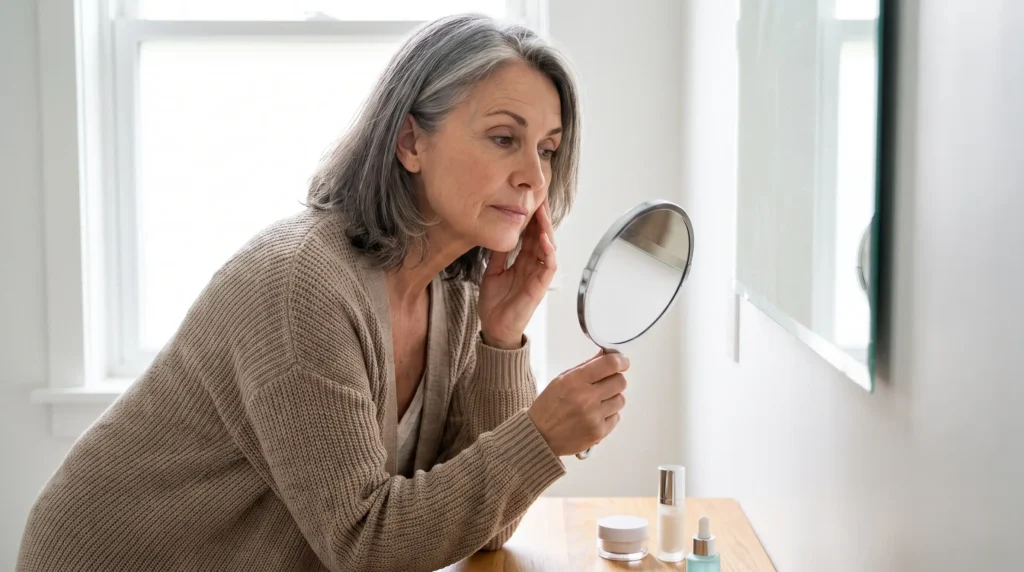
Skin contains estrogen receptors, which helps explain why hormonal changes can directly influence several aspects of skin physiology. Estrogen is involved in collagen synthesis, skin thickness, hydration-related processes, and barrier function. As estrogen levels decline during perimenopause and drop further after menopause, these processes are affected together, which may help explain why some women notice skin changes becoming more apparent during this transition.
When Do These Changes Start?
Skin changes can begin during perimenopause the transitional stage before menopause rather than appearing suddenly on the day menopause is reached. Timing and intensity vary considerably between women. If you’re in your early-to-mid 40s and already noticing changes in dryness or firmness, that’s consistent with the perimenopausal transition, not something to dismiss as premature.
The Most Common Menopause-Related Skin Changes
Collagen decline. Some studies have reported an approximately 30% reduction in skin collagen during the first five years after menopause, although the magnitude of change varies between individuals, followed by a slower decline of around 2% per year in subsequent years. This is steeper than the roughly 1% annual decline associated with general aging before menopause.
Reduced skin thickness. As collagen and elastin decline, the dermis, the skin’s structural layer becomes measurably thinner. Thinner skin is more fragile, bruises more easily, and shows fine lines and sagging more readily.
Changes in hydration. Estrogen influences several processes involved in skin hydration and barrier function. As estrogen levels decline, changes in skin hydration, thickness, and barrier properties can contribute to increased dryness, one of the most commonly reported menopausal skin changes.
Weaker barrier function. The skin’s lipid barrier, the layer that keeps moisture in and irritants out can become less effective with declining estrogen [1][3]. This is part of why skin that tolerated certain products for years may become more reactive during menopause.
Menopausal Skin Changes at a Glance

| Change | What You May Notice | What May Help |
| Lower collagen | Fine lines, reduced firmness | Retinoids may help support collagen; sun protection helps reduce additional UV-related collagen breakdown |
| Reduced hydration | Dry, tight-feeling skin | Humectants (hyaluronic acid) + moisturizer |
| Weaker barrier | Increased sensitivity, irritation | Ceramides, gentle cleansing |
| Reduced elasticity | Sagging, less resilience | Retinoids over time; sun protection to limit further UV damage |
| Increased reactivity | Stinging or irritation from products | Introduce new actives gradually, one at a time |
Common Myths About Menopausal Skin
Myth: Menopausal skin changes mean you’re not taking care of yourself. Fact: These changes are driven by hormonal shifts that affect collagen and hydration-related processes directly. No skincare routine fully prevents them; the goal is support, not prevention.
Myth: A heavier moisturizer alone solves menopausal dryness. Fact: Thicker texture can help retain moisture, but it doesn’t address the underlying hormonal shift. Ingredient choice humectants, barrier-supportive lipids matters as much as product weight.
Myth: Skin changes stop once menopause is established. Fact: The most rapid collagen decline happens in the first five years after menopause, but the decline continues afterward at a slower, ongoing rate. Support isn’t a short-term fix.
What Skincare Can and Cannot Change
Skincare can improve hydration, support the skin barrier, reduce the appearance of fine lines, and help protect against environmental damage like UV exposure. It cannot fully reverse the hormonal changes associated with menopause or restore skin to its pre-menopausal state. Setting realistic expectations is part of choosing an effective, sustainable routine.
Evidence-Based Ingredients for Menopausal Skin
Not all of these ingredients have equally strong evidence behind them, and strong evidence means different things depending on the specific outcome. Here’s how they compare:
Evidence is strongest for:
- Retinoids (including retinol) collagen production and photoaging. Decades of clinical research support their role in stimulating collagen and improving skin thickness and texture. Because some women experience increased dryness or sensitivity during menopause, gradual introduction may help improve tolerability.
- Ceramides barrier support. Evidence for barrier support from ceramide-containing moisturizers is well established, which matters more as estrogen decline weakens the skin’s lipid barrier.
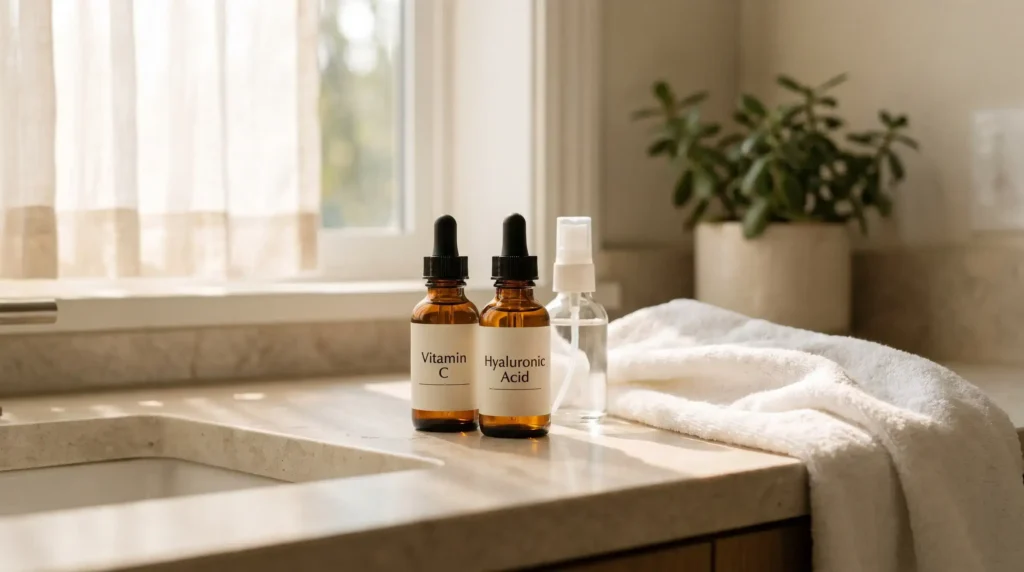
- Hyaluronic acid hydration. Strong evidence for topical hydration, helping offset reduced moisture retention at the skin’s surface.
Evidence is more formulation-dependent for:
- Vitamin C supports collagen-related processes and provides antioxidant protection, though results depend on formulation stability and concentration.
- Niacinamide supports barrier function and may help with increased sensitivity; evidence for these specific benefits is generally good but formulation matters.
Evidence is still developing for:
- Peptides may signal skin cells to support collagen-related activity, but evidence varies significantly by specific peptide type, and research is still developing compared to retinoids.
Sun Protection: The Non-Negotiable Step

Menopause-related changes don’t replace the need for daily sun protection if anything, they make it more important. UV exposure is a major contributor to collagen breakdown and premature skin aging, and this damage compounds on top of hormone-related collagen decline rather than existing separately from it. A broad-spectrum sunscreen should remain a core part of a menopausal skincare routine, regardless of which active ingredients you use.
When Is It Worth Starting a Targeted Routine?
There is no specific window during menopause after which skincare stops being useful. Addressing dryness, supporting the skin barrier, and using consistent sun protection can help manage symptoms and reduce additional environmental damage at any stage of the transition. Evidence-based ingredients such as retinoids can also support collagen-related changes over time, although individual results vary.
Who May Need a Different Approach
Women with pre-existing skin conditions such as rosacea, eczema, or significant sensitivity may need a more cautious, gradual approach to actives like retinoids, since menopausal skin can already be more reactive. In these cases, working with a dermatologist to sequence new ingredients is more appropriate than self-directed trial and error.
Common Mistakes When Adjusting Skincare for Menopause
- Assuming dryness only needs a heavier moisturizer, without addressing barrier or hydration ingredients specifically
- Introducing several new actives at once, making it hard to identify what’s causing irritation on more reactive skin
- Stopping retinoids at the first sign of irritation instead of adjusting frequency
- Expecting visible change within days collagen-related improvements typically take 8–12 weeks or longer to become noticeable
- Treating sunscreen as optional rather than foundational
Hormone Therapy and Skin: What to Know
Hormone therapy may affect some menopause-related symptoms and may also have documented effects on skin collagen and hydration. But it’s a medical treatment with benefits, risks, and contraindications that must be considered individually, based on your broader health picture, not skin appearance alone. It should not be started solely for cosmetic reasons without discussing the full implications with a qualified healthcare professional. Hormone therapy is not appropriate for everyone and should be considered based on individual symptoms, medical history, risks, and benefits.
Not Every Skin Change Is Caused by Menopause
Menopause can explain many changes in dryness, sensitivity, and elasticity, but not every new skin symptom should automatically be attributed to hormonal changes. Persistent itching, new rashes, rapidly changing lesions, or wounds that don’t heal normally warrant professional evaluation rather than being assumed to be just menopause.
When to See a Dermatologist or Doctor
See a dermatologist if skin changes are accompanied by persistent itching, unexplained rashes, or unusual changes in how skin heals. It’s also worth discussing menopausal skin changes with your doctor if you’re considering hormone therapy, since that decision depends on your overall health, not skin alone.
The Bottom Line
Menopausal skin changes are driven by measurable hormonal shifts, not a lapse in skincare habits.
Collagen decline, dryness, and increased sensitivity are expected parts of this transition and while no routine reverses the hormonal cause, ingredients like retinoids, ceramides, and hyaluronic acid have real evidence behind their ability to support skin through it, alongside daily sun protection. The most effective approach is consistent, gradual, and realistic about timelines, not a search for a single product that undoes hormonal change.
Related Posts
Editorial & Research Methodology
This article was researched using peer-reviewed studies and clinical guidance from established dermatology and medical organizations. Claims about menopause-related skin changes were prioritized from published research on estrogen, collagen, skin thickness, hydration, and barrier function. Evidence for individual skincare ingredients was evaluated separately, recognizing that the strength of evidence varies by ingredient, formulation, and intended use. Sources were selected based on relevance to menopause-related skin physiology and the clinical evidence available for topical skincare ingredients. Medical claims were cross-checked against peer-reviewed literature and dermatology guidance where available.
Medical Disclaimer: This article is for informational and educational purposes only and does not replace individualized medical advice. If you are considering hormone therapy or have a diagnosed skin condition, consult a qualified healthcare provider or dermatologist.
References
- Brincat MP, Baron YM, Galea R. Estrogens and the skin. Climacteric. 2005;8(2):110-123. PubMed
- Affinito P, Palomba S, Sorrentino C, et al. Effects of postmenopausal hypoestrogenism on skin collagen. Maturitas. 1999;33(3):239-247. PubMed
- Hall G, Phillips TJ. Estrogen and skin: the effects of estrogen, menopause, and hormone replacement therapy on the skin. Journal of the American Academy of Dermatology. 2005;53(4):555-568. PubMed
- American Academy of Dermatology Association. Caring for your skin in menopause. AAD.org. AAD