Key Takeaways
- Sunscreen for anti-aging is the single most effective skincare product for preventing wrinkles, dark spots, and collagen loss ahead of retinoids, vitamin C, and professional treatments.
- SPF 30–50 broad-spectrum applied daily provides meaningful protection; SPF 100 doesn’t double the protection of SPF 50.
- UVA rays, the primary driver of photoaging, penetrate clouds and glass, making application non-negotiable regardless of weather or indoor plans.
- A quarter teaspoon for face and neck is the correct dose; most people apply 25–50% of what’s needed.
- The biggest sunscreen mistake isn’t forgetting it on sunny days, it’s inconsistent application on ordinary days.
What Is the Best Sunscreen for Anti-Aging?
The best sunscreen for anti-aging is a broad-spectrum SPF 30 or higher that you apply every morning as the final step of your skincare routine. Consistent daily use prevents wrinkles, collagen breakdown, dark spots, and photoaging more effectively than any skincare serum.
Who This Guide Is For
This article is most relevant if you:
✔ Want to prevent wrinkles and slow visible skin aging ✔ Are using retinoids (which increase sun sensitivity) ✔ Have hyperpigmentation or melasma concerns ✔ Spend time near windows or commuting regularly ✔ Have mature skin (40+) seeking a complete anti-aging approach ✔ Are unsure whether your current SPF is actually working
Why UV Radiation Ages Skin Faster Than Time
Most visible facial aging wrinkles, uneven tone, loss of firmness, rough texture is photoaging: damage driven by UV radiation, not the passage of time. Research consistently attributes approximately 80% of visible facial aging to cumulative UV exposure. The landmark Annals of Internal Medicine study (Hughes et al., 2013) found that adults using SPF 15+ daily showed measurably less skin aging over four and a half years than those who used it only when they chose to.
Two types of UV radiation reach skin from sunlight:
UVA (320–400 nm): Penetrates deeply into the dermis where collagen and elastin live. Generates reactive oxygen species that activate matrix metalloproteinases (MMPs) enzymes that fragment collagen fibres. Causes solar elastosis: the degradation of elastin fibres that gives photoaged skin its characteristic loose, leathery appearance. UVA intensity is relatively consistent year-round and penetrates both clouds and standard window glass.

UVB (280–320 nm): Primarily affects the epidermis. Causes sunburn, direct DNA damage, and is the dominant driver of skin cancer risk. UVB intensity varies by season, time of day, and latitude. Most glass blocks UVB; window exposure is primarily a UVA concern.
The practical implication: consistent UVA protection through broad-spectrum sunscreen applied daily is what prevents the deep collagen and elastin damage that produces visible aging. Wearing SPF only on obviously sunny days is insufficient because UVA exposure is happening on every day you spend near windows or outdoors, regardless of whether you burn.
What Happens If You Skip Sunscreen for a Year
The effects aren’t visible immediately photoaging is cumulative. Each unprotected day adds to a lifetime total. Skin cells carry UV damage in their DNA across cell divisions. The age spots, fine lines, and loss of elasticity that appear prominently in the 40s and 50s often reflect cumulative exposure from the 20s and 30s.
People who worked outdoors in their youth but have used consistent SPF since their 30s often show significantly better skin quality in their 50s than those who protect only intermittently. This isn’t about a year of damage, it’s about the compounding of daily decisions over decades.
Choosing the Best Sunscreen for Anti-Aging
The right sunscreen for anti-aging isn’t the one with the highest SPF, it’s the one you’ll use every morning. Formulation determines whether that actually happens.
| If you have… | Best Choice |
| Rosacea or reactive skin | Mineral-only (zinc oxide, fragrance-free) |
| Melasma or post-inflammatory hyperpigmentation | Tinted mineral with iron oxides |
| Acne-prone or oily skin | Lightweight gel or fluid chemical SPF |
| Dry or mature skin | Cream formulation with ceramides or glycerin |
| Darker skin tone (white cast concern) | Tinted mineral or transparent chemical filter |
| Outdoor sports or swimming | Water-resistant SPF 50 (mineral or chemical) |
| General daily anti-aging | Whichever texture you’ll actually apply every day |
Mineral sunscreens (zinc oxide, titanium dioxide) sit on the skin surface and reflect or scatter UV. Zinc oxide alone provides the broadest UVA coverage of any single filter. Effective immediately. Better tolerated by sensitive skin. Modern formulas have significantly reduced the white cast problem.
Chemical sunscreens absorb UV and convert it to heat before it damages skin. Typically lighter in texture and more cosmetically elegant. Need 15–20 minutes to bind to skin before sun exposure. Some filters (oxybenzone, octinoxate) sensitise reactive skin.
Both categories work effectively when formulated with broad-spectrum coverage. The performance difference between a well-formulated mineral and a well-formulated chemical SPF is smaller than the difference between either and inconsistent application.
Best SPF for Anti-Aging: Does SPF 100 Matter?
SPF measures UVB protection specifically. Here is what the numbers actually mean:
| SPF | UVB Blocked | UVB Reaching Skin |
| 15 | 93% | 7% |
| 30 | 97% | 3% |
| 50 | 98% | 2% |
| 100 | 99% | 1% |
Why SPF 100 doesn’t protect twice as well as SPF 50: The difference between SPF 50 and SPF 100 is one additional percentage point of UVB blocked (98% vs 99%). In real-world conditions where people under-apply, sweat, or miss spots this difference is negligible. What matters is broad-spectrum coverage (UVA + UVB) and applying enough product.
SPF does not measure UVA protection. “Broad spectrum” on the label is what guarantees proportional UVA coverage. In many Asian formulations, the PA rating (PA+ through PA++++) specifically grades UVA protection; PA++++ is the highest available.
How to Apply Sunscreen for Anti-Aging Correctly
The Dose Problem
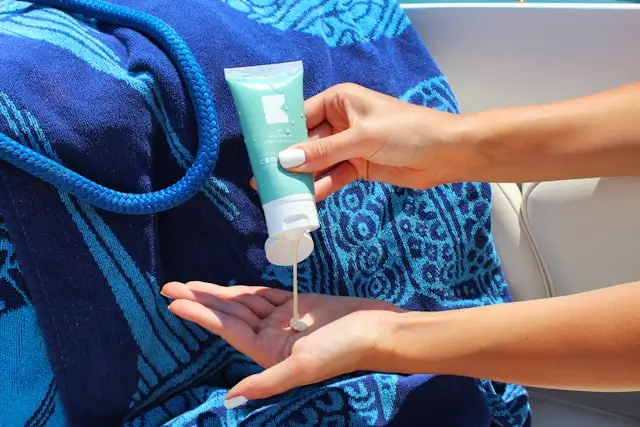
The SPF rating on any sunscreen assumes approximately 2mg per cm² of skin for face and neck, that translates to a quarter teaspoon (about 1.5–2 finger-lengths from the bottle). Most people apply 25–50% of this, which can effectively reduce an SPF 50 to the functional equivalent of SPF 10–15.
Step-by-Step
- Apply as the last step in your morning routine after moisturiser, before makeup
- Dot across forehead, cheeks, nose, and chin; blend outward and downward to include neck
- Include ears, hairline, eyelids, and the back of the neck areas that consistently show sun damage
- For chemical sunscreens: allow 15–20 minutes before sun exposure for filters to bind
- For mineral sunscreens: protection is immediate
- Reapply every 2 hours during extended outdoor exposure; powder or stick SPF makes reapplication over makeup practical
Extending Past the Face
The neck, chest, and backs of hands receive comparable UV exposure to the face. These areas consistently show aging earlier than the face when routinely neglected. One of the most striking examples of photoaging is the difference between the inner upper arm (usually covered and protected) and the back of the hand (chronically exposed) in people of the same age.
What Science Supports and What It Doesn’t
| Claim | Evidence | Strength |
| Daily SPF prevents photoaging | Annals of Internal Medicine RCT (2013) | ✅ Strong |
| SPF prevents collagen degradation | Multiple photoaging mechanism studies | ✅ Strong |
| SPF reduces pigmentation and sunspots | Consistent in photoaging literature | ✅ Strong |
| SPF + vitamin C provides greater protection than either alone | JAAD (2005) Lin et al. | ✅ Strong |
| SPF reverses existing wrinkles | No evidence | ❌ Not supported |
| SPF restores lost volume or elasticity | No evidence | ❌ Not supported |
| SPF treats broken capillaries or rosacea | No direct evidence | ❌ Not supported |
| SPF prevents all skin cancer | Reduces risk significantly; does not eliminate | ⚠️ Partial |
The honest summary: sunscreen for anti-aging is prevention. Not correction. What’s already there existing wrinkles, volume loss, deep folds, solar elastosis requires active treatments or professional procedures. But preventing new UV-driven collagen degradation from accumulating is both the most evidence-based and the most cost-effective long-term investment in skin appearance.
5 Sunscreen Habits That Matter More Than SPF Number
1. Consistency over concentration. SPF 30 applied daily delivers better outcomes than SPF 100 applied twice a week. The Hughes et al. study specifically demonstrated that daily use drove the anti-aging benefit not SPF level.
2. Apply enough. A thin layer isn’t sufficient. If your SPF spreads into invisibility before you’ve covered your full face, you haven’t used enough. A properly dosed daily SPF should be fully used in 2–3 months for one person.
3. Treat windows as outdoor exposure. Consistent application before sitting near a window at work is one of the highest-impact changes most office workers can make, given how much cumulative UVA this represents across a working week.
4. Never skip on cloudy or cold days. Up to 80% of UVA and UVB radiation reaches skin on overcast days. Seasonal or weather-dependent SPF use is the single most common reason people who “always wear sunscreen” still develop significant photoaging.
5. Pair with an antioxidant. A 2005 study in the Journal of the American Academy of Dermatology found that combining vitamin C and E with SPF provided significantly greater photoprotection than sunscreen alone. Our anti-aging ingredients guide covers the full evidence for this combination.
Who Should Choose SPF 30 vs SPF 50?
| Situation | Recommendation |
| Everyday office | SPF30 |
| Outdoor work | SPF50 |
| High UV index | SPF50 |
| Mountains | SPF50 |
| Beach | SPF50 |
What Dermatologists Do Themselves
Surveys and interviews with dermatologists consistently show that daily sunscreen use is one of the most common habits they personally follow and recommend to patients.
One of the most common observations in dermatology practice is that patients who present with significant sun damage in their 40s and 50s typically describe the same pattern: they wore sunscreen at the beach but rarely on ordinary days. The cumulative damage from thousands of commutes, lunch breaks, and window-side hours each individually unremarkable adds up to more total UV exposure than most beach holidays combined.
This is why consistent daily application on ordinary days, rather than intensive application on obvious sun days, is what separates those who maintain significantly younger-looking skin at 60 from those who don’t. For a complete morning and evening routine that puts SPF in proper context, our skincare routine over 40 guide covers the full picture.
Related Posts
- Anti-Aging Skin Care: Ingredients That Actually Work (Backed by Science)
- Best Skincare Routine Over 40: Morning & Night Steps That Actually Work
- Why Hyaluronic Acid Sometimes Makes Your Skin Drier (And How to Fix It)
- Anti-Aging Guide: Science-Backed Skincare, Treatments & Daily Habits
Frequently Asked Questions
Does sunscreen actually prevent wrinkles?
Yes with consistent daily use. The Annals of Internal Medicine randomised controlled trial found measurably less skin aging in daily SPF users over four and a half years. The mechanism is well-established: UV radiation activates matrix metalloproteinases that degrade collagen, and broad-spectrum SPF blocks the UV that triggers this. Sunscreen prevents new damage from accumulating; it does not reverse wrinkles that already exist.
Is SPF 50 worth it over SPF 30?
Marginally. SPF 30 blocks 97% of UVB; SPF 50 blocks 98%. The one-percentage-point difference is small in real-world conditions. What matters more than SPF number is broad-spectrum coverage, applying sufficient quantity, and applying consistently every day. A well-applied SPF 30 outperforms an under-applied SPF 100 every time.
Can I skip sunscreen if I work indoors?
No. UVA rays penetrate standard window glass sitting near a window at work for several hours provides meaningful cumulative UVA exposure, the wavelength most responsible for collagen degradation and photoaging. Commuting, walking between buildings, and outdoor lunch breaks add further. Daily morning application regardless of plans is the most reliable approach.
Should I wear sunscreen in winter?
Yes. UVA intensity varies less by season than UVB does. While UVB drops significantly in winter at higher latitudes, UVA remains relatively consistent year-round. Snow also reflects UV significantly, increasing exposure during winter outdoor activities. Daily SPF is a year-round habit, not a seasonal one.
Does sunscreen stop collagen loss?
It significantly reduces UV-driven collagen degradation. UV radiation generates reactive oxygen species that activate enzymes breaking down collagen fibres broad-spectrum SPF blocks the UV triggering this cascade. Sunscreen cannot prevent the natural age-related collagen decline that occurs independent of UV exposure, but it eliminates what research suggests is the dominant driver of collagen loss in photoexposed skin.
Can sunscreen reverse aging?
No. Sunscreen prevents future UV damage and allows existing repair mechanisms to work more effectively but it cannot rebuild collagen already lost, restore volume, eliminate existing wrinkles, or reverse solar elastosis. Active treatments (retinoids, professional procedures) address existing damage; sunscreen prevents it from worsening and prevents new damage from forming.
Daily SPF is not the most exciting skincare step; it doesn’t visibly transform anything immediately. What it does is prevent the accumulation of damage that determines how skin looks at 50, 60, and beyond. The difference between skin that ages gracefully and skin that ages rapidly is written in thousands of ordinary, unremarkable daily UV exposures over decades. Consistent sunscreen for anti-aging is what controls that variable.
References:
- Annals of Internal Medicine Daily sunscreen use and skin aging outcomes (Hughes et al., 2013)
- Journal of the American Academy of Dermatology Vitamin C, E, and sunscreen photoprotection (Lin et al., 2005)
- PubMed Matrix metalloproteinases and UV-induced collagen degradation: mechanisms review
- American Academy of Dermatology Sunscreen: how to select, apply, and use
- British Journal of Dermatology UVA transmission through glass and cumulative photoaging risk